All clever humans say not to start a story with a storm and rain in a dark night. But I am a donkey and I can’t think of anything better.
Rain pours down and the fertile land turns to mud. Humans and animals, all God’s creatures, with rubber shoes and bare feet and hooves thick with grime, we wade through it. At times a child cries out or a dog gives a short throaty growl. And it is quiet again, and only the squelch of each footstep disturbs the silence. The throng of people drags for miles, straggles from end to end of the crop fields and zigzags through forests. And the way is lightened only by the Worm Moon.
Master is the first one of our family to walk leading me by the reins. His staff splatters mud when hits the ground. He walks with eyes cast down. Once he stops to look at west where the village is. And a long and quiet look that is. He moves and gingerly pulls my reins. I drag the cart, heaped with bundles of possessions. Mistress sits on top of them with baby John. My hooves sink deep, I brey and stop. ‘Shush…we have to cross the river’, says Master and pulls on the reins again. And in silence and darkness we are heading eastwards.
That evening when we have left, Master comes to me in the stable. I sniff his shirt and sense something is different tonight. He puts the halter on me and hitches the cart and takes me out. Not a single word he utters. Master faces the house and goes around it. His hand is running along the window sill, and the handle and oak door, and the whitewashed wall and stone corner. ‘A little gem nestled in the groove’, Master always says. It has witnessed weddings and birthdays and Christmases, and handed down from a father to son.
Master hurries in and out the house and piles bundles in the cart. ‘It’s too heavy. We’ve to leave some behind,’ says he and throws a few bundles against the wall and runs back in. Mistress dashes out with baby John in hands. Before climbing on the top of the cart, she touches a bud of the apple tree she planted after John’s birth.
The house door gapes open as if to scream and the windows turn black like deep caves. The house starts smoking and cracking and hissing. And flames loom and lick the walls and envelop it whole. ‘Let’s go!’ Master shouts and pulls my rein, but the roar of the fire drowns his voice.
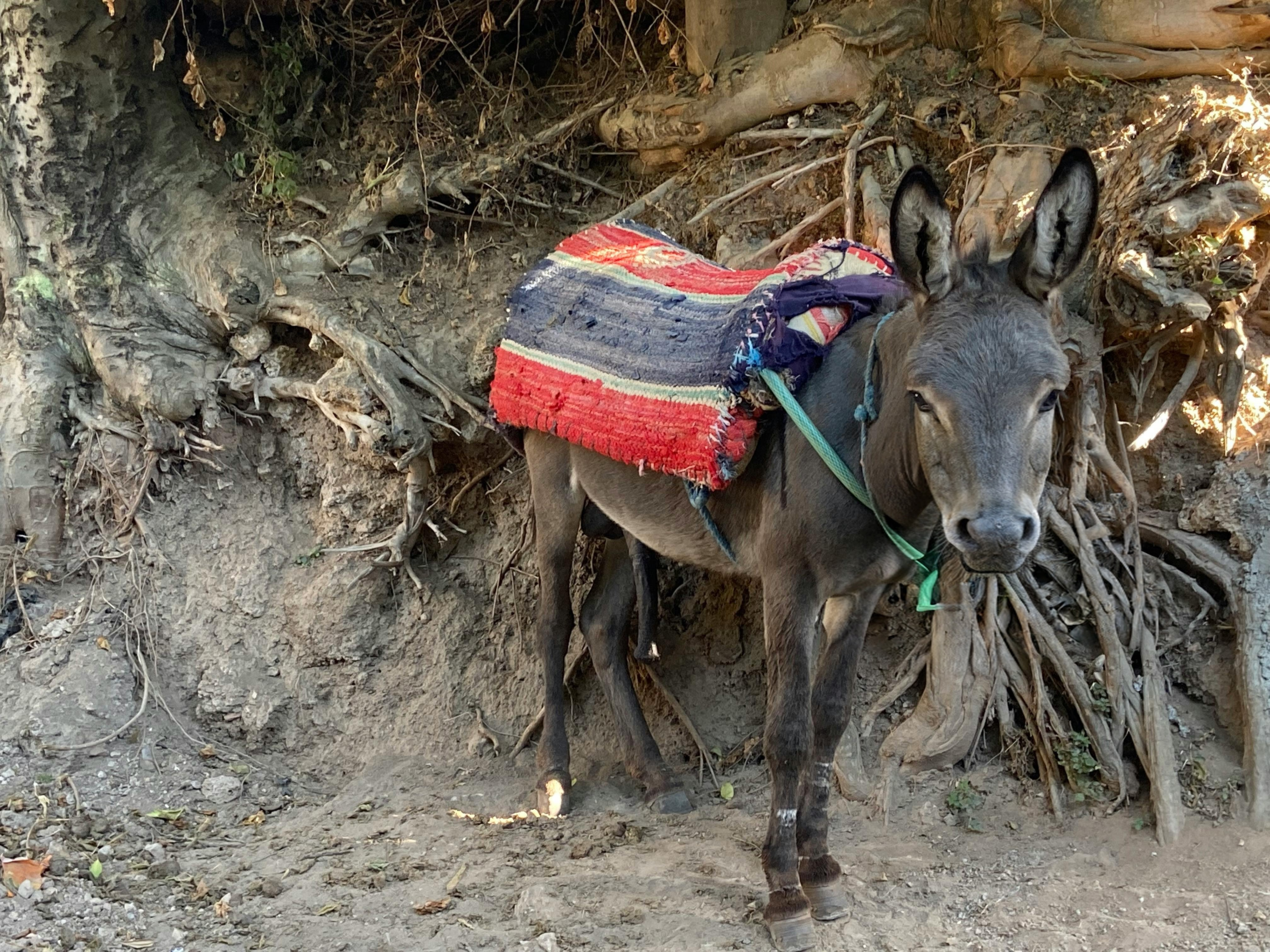
I don’t move a hoof. This is my home. I was born in these stables by modest parents. My birth was a sign that the house is blessed, for a glossy and sturdy little thing I was born. Not grey but white. And a white donkey for us, the four-leg creatures, is like a saint for the humans.
Master was a young boy then and we have been growing together since. I graze on the lush farm pasture and run through it and drink on the brook and rest for hours on end. At twilight, Master comes to me and takes me to the stable, and stroke my main. ‘You’re noisy and stubborn, but it’s not all bad about you, my friend. You’re stoical and loyal’, says he and strokes me again. I lie down and munch on oats and he sit opposite me and tells me a story.
‘Once upon a time an ancestor of yours, yes a donkey, had the Mother on his back, and clip-clop he took Her to that manger to give a birth to the Son. And the Son grows and becomes the Messiah’, Master says. ‘And the Messiah travels as a humble preacher and peace maker riding a white donkey, and not as a lord to wage a war on the back of a proud horse.’
Master grows to become a strong man, broad in the shoulder and bold in the eye. And comes the time for his wedding day. On his way he goes, with me, of course! We take the road across the pasture, along the brook to the forests. And a sunny day of March it is, with all the daffodils in blossom and bluebirds warbling. I’m pulling the cart for the bride and her possessions. Master is proud and I am slow. He picks a daffodil and puts it in his buttonhole, and puts a few on my halter and strokes my head and says, ‘Don’t munch on them, my friend!’ And his laugher is as radiant as the spring sun.
But here and now, I am in the hardest of times. And I have to pull the cart and go by the side of the family to take them to safety.
‘It’s a long way to go, my friend, we have to go!’ says Master and strokes my head and gives me a piece of bread. We take the same road that we set off on the wedding day to take Mistress. It’s March yet again but no daffodils. It starts drizzling. ‘It’s good for the crops,’ Master would say in better times but now only pops up his coat collar, looks up to the darkening sky and murmurs, ‘To Hell with it!’
Through the fields more villagers coming and a throng of people wade careless of the hard labour they put in autumn to seed the crops. The Worm Moon marks the time when the ground wakes and warms up. The wheat starts just now to push up though the soil hopeful for the spring warmth and rain.
But the Worm Moon is clouded. The sky is darkened now. Like a flock of sheep that has lost their shepherd people go. Carts and wagons pulled by horses or donkeys, dogs and sheep and cattle flounder along, and they all venture into the forests.
Human and animal bodies lie in preternatural positions and no one stops to bury them. A crow, dour and unsatiable and insolent, swishes through the oak tree branches and descends next to a dead horse and feeds on it. The drizzle turns to a torrent. Raindrops, sharp and hard like a smack in the face, pelt down and mix with earth and ashes and dust.
The forests go steep now. My legs sink in the mud above my hooves, and the cart wheels sink deeper and deeper with any further move. Master pushes one wheel with his shoulder but the cart doesn’t budge. ‘Damn it, it’s broken. We go on foot now’. He unfastens the halter, and takes John and a bundle of bread and ties them to my back.
‘Once we go over the hill, my friend, it will be easy. Then you have to take care of Mistress and John, and cross the river, and I have to go and do my job…whatever men do at war.’
And a sweet thought springs to my mind. I think about the future when the war is over. We are back home and Master and Mistress plan to repair and whitewash the house, and I roam and graze on the pastures and play with John…
Master takes a breath and with a heave pushes the cart downhill. It jumps and sways, cracks and screech, hits a tree and jerks to a halt. The loose wheel gets separated, spins for a while and tumbles a few yards apart. Master stares at it and spits down.
With a pull of the reins and a prod of the staff, off we go. I look at Master. The eyes are void and secretive, and a furrow, like a gaping wound, halves his forehead. Grey stubble has grown on his chin and cheeks, and his shoulders has hunched. Any time he hits the earth with his staff mud splatters up to his knees.
The first rays of sun shine through the thick forest canopy. Waters roar down in the valley and the echo travels for miles. The river is down there. The banks can’t confine it now. The white rapids upstream merge with rainwater and silt and clay. It has grown, wild and deep, and ghoulish. Torrents run and swash over cobblestones and boulders and rocks. Clumps of soft earth, gnawed at by currents and winds, crumble in the water with a thud and splash. And it takes all. Abandoned possessions, fallen trees, stiff carcasses.
An awe to behold! People stop and listen and watch the dance macabre.
The river, invincible and heartless, witnesses the throng of people wading the ford, tripping and falling and rising, pushing carts and wagons, dragging children and animals in one last, the most obstinate hope for survival. But many a time a soul is taken by the whirlpools. They struggle and scream and pray, and give up.
We have reached the ford. Grey froth is washing my hooves. I may be slow on thinking but I sense danger and refuse to go. I have to protect my family. Master pulls the reins.
‘Com’on, my friend, let’s go!’ His voice has never been so raspy. His staff has never been so heavy on my back. ‘There’re donkeys among people too, my friend, more stubborn than you…and when them important jerks start kicking each other that’s when little sous, like you and me, snuff it…’
His lips quiver as he speaks. Master strokes my back. I know his hands. They are gentle, though hefty from the hard work. But they never shake like this. And he holds the staff with these two hands and strikes.
Whak! The first blow doesn’t hit my knee. I wince and bray. I wonder what has happened to these hands that fed me, and this voice that told me stories, and that mind that could read mine whenever I was hungry or thirsty or tired.
He raises the staff to hit again.
Mistress stands between two of us. ‘Don’t, please, it’s not his fault, he doesn’t understand…’ He wipes his tears with a sleeve. ‘No, they won’t have him, no…’
He aims again. He hits. The second blow does the trick. Pain shoots from my knee up to my spine to my heart. The joint is smashed. Blood spouts out and trickles down my leg. As I shake, Master aims the other knee. Hits and breaks it on the first time. I fall. I fall on my knees as humans do to pray to their God. I want to ask Master what I have done to him to strike me three times?
Water, choked with mud and blood and filth, surges up to my chin.
The Worm Moon has faded. The sun, bright and formidable and eternal, is too busy to see or hear a little creature like me. It will not change its trajectory or wince at trivial worldly deeds.
Thus, my story ends.
If you don’t like this end and see me swollen and stiff, I could think of another one. I turn my back on humans and walk away, walk on the pure white water and cross the river, away from pain and blood and death.
© 2026 Homo Ignoramus. All rights reserved.